
You believe you can learn anything except the one thing that’s hurting you.
Think of the last piece of criticism that genuinely stung.
Not the unfair one — the unfair ones are easy; you dismiss those by lunchtime. I mean the one that stayed. The sentence you were still turning over three days later, at a red light, for no reason you could name.
Here’s the uncomfortable part.
It didn’t hurt because it was cruel.
It hurt because some quiet part of you already agreed with it.
Hold that thought — we’re coming back for it. Because before we can do anything with that sentence, you need to see something strange about yourself. And I mean it kindly.
You already have a growth mindset
If someone told you today that you could learn a new language at fifty-four, you’d believe them. Learn to cook, learn to code, learn to swim, learn to speak in front of a room without your voice shaking — you might grumble about the effort, but somewhere in you, you’d accept that it’s learnable. That you’re simply someone who hasn’t done it yet.
Now say this one out loud:
“I’m just not the kind of person people stay for.”
And watch how differently your mind treats it. Not as an opinion. Not as a habit. As a fact about the universe — filed somewhere between gravity and the boiling point of water. Permanent. Structural. Nothing to be done.
That’s the trick. Almost nobody has a fixed mindset about their skills anymore; we’ve all read the posts. The fixed mindset didn’t die. It moved house.
It lives, quietly and expensively, in what you believe about your worth.
What the research actually found
Carol Dweck — the psychologist whose work sits under all of this — drew a line between two ways of holding ability. A fixed mindset treats your qualities as issued at birth: you either have it or you don’t. A growth mindset treats them as developable — through effort, strategy, and honest feedback.
In her classroom research, students were taught one simple idea: intelligence isn’t fixed; it grows with use, the way a muscle does. Nothing else changed. Same school, same teachers, same syllabus.
Their motivation, resilience, and results improved.
Not because they got smarter overnight — because they stopped treating every difficult question as an exam on their worth, and started treating it as a question.
Read that again, because it’s the entire mechanism: the belief changed before the results did.
It’s a well-travelled finding, repeated so often it’s lost its teeth. So let me put it where it actually bites.
Where it actually bites
Feedback. Two people are told the same thing: “This isn’t working.”
The first one hears I’m not good enough. The sentence isn’t about the work anymore — it’s a verdict on them as a person. So they defend, explain, go quiet for three days, and quietly avoid the person who said it. Notice how that plays out at home: “you don’t listen to me” is either something to look at, or an attack to survive. Same sentence. Two entirely different marriages.
The second one hears something in my approach is off. Same words, completely different room to stand in. They can stay curious — because nothing about their existence is on the table.
Failure. In a fixed mindset, failure is a description of you. You didn’t fail; you are a failure. Which is unbearable — so you stop attempting. And that’s the real cost, the one nobody warns you about: a fixed mindset doesn’t stop you from failing. It stops you from trying. You take the safe project. You don’t ask the question in the meeting. You stay in the relationship you’ve outgrown, because leaving would mean admitting you chose wrong.
From the outside it looks like caution. From the inside it feels like protecting yourself. It’s neither. It’s a slow, polite shrinking — and the worst part is that it works. You do avoid the failure.
You also avoid the life.
Effort. The fixed-mindset story says successful people were born different. Look closely at anyone who’s actually built something, and you’ll find the opposite: a long, boring record of falling, adjusting, and going again. What separates them isn’t that they fell less. It’s that they spent less time lying on the ground arguing about the fall — they dropped “why did this happen to me?”, which has no useful answer, and picked up “what in my approach needs to change?”, which always does.
The part everybody gets wrong
Ask most people what the opposite of a fixed mindset is, and they’ll say confidence.
It isn’t.
The opposite of a fixed mindset is curiosity.
Confidence still needs to be right. It still has a self-image to protect — it’s just protecting a flattering one instead of a punishing one, and it collapses the moment reality disagrees. Confidence is a fixed mindset in better clothing.
Curiosity has nothing to protect. It can look directly at the worst feedback it’s ever received and ask, honestly, is any of that true? — and survive the answer either way. That’s not a personality trait. That’s a practice. And it’s available to you today, in the middle of feeling terrible about yourself — which confidence is not.
Being versus behaving
Now we can come back to your sentence — the criticism that stung. Because here is the one practice I’d give you if I could only give you one.
Catch the word am.
I am unlovable. I am too much. I am not the kind of person people stay for. I am just like this.
Every one of those is a sentence about being. Being-sentences are verdicts: permanent, closed, unfalsifiable. There’s no action item at the bottom of a verdict — which is exactly why it feels so heavy. It’s a life sentence.
Now translate each one into behaving:
I have been choosing people who can’t give me what I need.
I have been apologising for taking up space — and then resenting people for the space I gave away.
I have been leaving before I can be left.
Same life. Same painful evidence. Completely different door.
Because behaviour has a history. It started somewhere; it was learned, usually early, usually for a very good reason at the time. And anything that was learned can be examined. Anything examined can be changed. A behaving-sentence isn’t a verdict — it’s feedback. Not a life sentence. A to-do list.
And to be clear: this is not positive thinking. Positive thinking would tell you the first set of sentences is false. I won’t insult you like that — you have years of evidence, and you’re not an idiot. I’m telling you it’s the wrong grammar. You collected real data and drew a conclusion about your being, when the data only ever supported a conclusion about your behaving.

What the verdict costs
Every fixed belief about your worth quietly writes a rule — and you follow the rule without ever seeing it.
I’m too much → so you shrink → and now you’re lonely in rooms full of people.
I have to earn love → so you over-give → and now you’re exhausted, resentful, and can’t understand why you feel used by people you handed everything to.
I always get left → so you leave first → and the belief collects one more piece of evidence, and now it’s even more true than it was yesterday.
The belief doesn’t just sit there. It manufactures its own proof. That’s why it feels so much like a fact.
And it’s why I hear the same sentences, week after week, from people in relationship pain: “I always pick the wrong people.” “I’m just bad at this.” “Something’s broken in me.” Those aren’t observations. They’re verdicts. And a person who has issued themselves a verdict will keep choosing the same person, the same pattern, the same ending — because if the outcome is fixed anyway, why examine it?
It’s why you can get back up from the same heartbreak four times and still find yourself standing in front of a fifth, wondering what’s wrong with you.
Nothing is wrong with you. You’ve been repairing the event — and never the rule.
Where the rules were written
The rules about your worth were written long before the relationship, the job, or the failure that exposed them. Often they’re a single sentence — something someone said to you when you were nine — that you’ve been quietly obeying ever since. Usually written by a child who was doing their absolute best with the information they had.
That child isn’t wrong.
That child is just out of date.

Try this today
Take the criticism from the top of this piece — the one that’s still sitting in you.
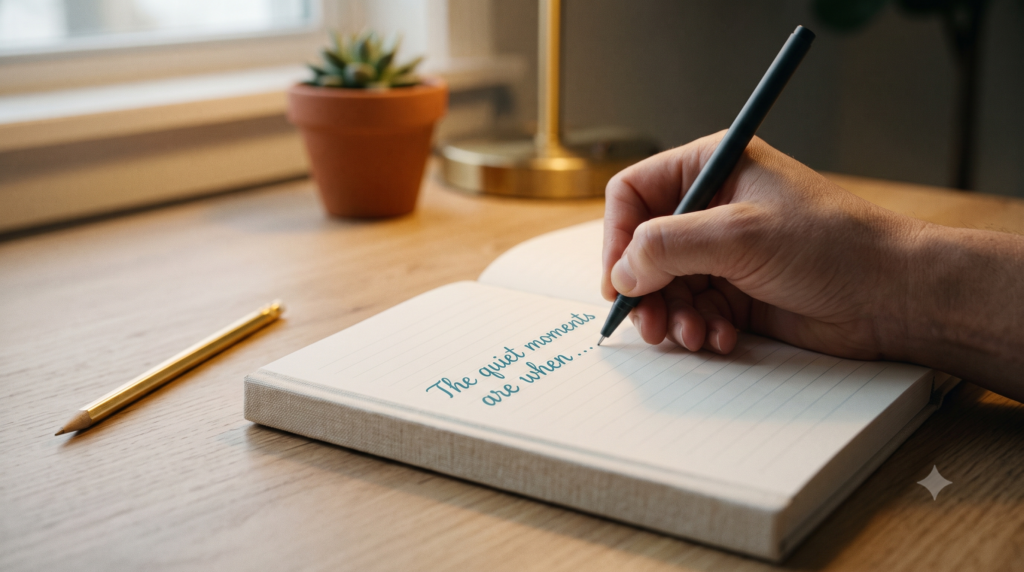
Write it down in one sentence.
Then check the grammar: is this a verdict, or is it feedback? A being-sentence, or a behaving-sentence?
If you’ve written “I’m not good enough” — that’s a verdict, and you already know verdicts can’t be worked with. So rewrite it as behaviour: specific enough to act on. “I interrupt people when I’m anxious.” “I apologise to keep the peace instead of saying what I actually mean.”
You’ll find the second version is uncomfortable in a completely different way — a way that has a door in it.
Sometimes you can walk through that door alone. And sometimes the verdict is so old that you can’t see it as a belief at all — it just looks like the truth about you. You can’t examine the water you swim in. That’s usually when a second pair of eyes helps: not to comfort you, but to show you the rule you’ve stopped noticing.
If you’d like to look at yours together, you can book a conversation at topmate.io/mitrra. Bring the sentence. We’ll work out whether it’s a verdict or feedback — and if it’s a rule, we’ll find out when it was written.
You’ve already accepted that you can learn to speak a new language.
Start with the one you use on yourself.
— Mitrra